Introducing Our “Know Flood Insurance” Flood Insurance Service Center: A place to have your flood insurance questions answered
Have a question about flood insurance or your flood policy? You’ve come to the right place. The MCC knows the value of understanding flood insurance. Over the years, we have fielded thousands of inquiries about flood insurance and have come to realize there is no single place for stakeholders to get simple, straightforward answers to flood insurance questions.
That’s why the MCC is proud to present our flood insurance service center, run by MCC flood expert Art McKinney. Art is a twenty year insurance veteran and has spent over five years working as a flood insurance marketing consultant. Art holds the Associate in National Flood Insurance (ANFI) designation and works with independent insurance agents throughout northeast helping them better understand flood insurance and service flood insurance products.
Art joins the MCC as a flood underwriter to assist stakeholders with questions regarding flood insurance. The MCC will do its best to answer broad and specific flood insurance questions, or get you an answer.
To submit a question or concern about flood insurance: -Simply go to www.knowflood.org/services and look for the “Know Flood Insurance Information†section. -Fill out the form, attach any relevant information such as a flood policy and/or an elevation certificate. -We will respond via email within the stated hours of operation of Tuesdays 6pm-8pm and Thursdays 7pm-9pm.
One more way the MCC is helping you “Know Floodâ€.
Welcome Tim van der Veen, Esq The MCC has voted in a ninth board member, Tim van der Veen. Tim graduated from UMass-Amherst with a B.S. in Mechanical Engineering. After working as an engineer for several years, Tim enrolled at Suffolk Law School, graduating Magna Cum Laude in 1996. While at Suffolk, Tim was a member of Law Review, publishing two articles on union labor issues. After law school, Tim practiced as a litigator in Boston with a focus on complex commercial disputes and insurance defense work. In 2003, Tim left the litigation world and formed his own firm dedicated exclusively to real estate. Since 2003, Tim has handled thousands of real estate transactions throughout Massachusetts. In the past 10 years, Tim has hosted or participated in more than 100 real estate classes and workshops throughout eastern Massachusetts. As a licensed real estate instructor, Tim also teaches realtor certification and continuing education classes through his chartered school, Real Angels Academy.
Update from Q2 newsletter: Maps Back Up!
After a website crash, the “Know Flood Map Service†FEMA flood map search service is back up and running. We apologize for the temporary down time, as availability is critical to serving our members.
We plan on updating the service to include other critical mapping layers later this year.
Coastal Connection
Understanding New Private Flood Insurance Lending Regulations
When Congress passed the Biggert Waters Act of 2012 (BW12), the intent of Congress to make it easier for lenders to accept private flood insurance to satisfy the mandatory purchase requirement. However, what the Act did was create vague language that took lending regulators seven years to finalize. Since the lending regulators had to crate the final rule around the legislative language, lenders worried that accepting the wrong private flood policy could be seen by a regulator as a violation of the law and a fine of thousands of dollars. In January, the Office of the Comptroller of the Currency (OCC), the Board of Governors of the Federal Reserve System (Board), the Federal Deposit Insurance Corporation (FDIC), the Farm Credit Administration (FCA), and the National Credit Union Administration (NCUA) (known going forward as the Regulators) issued their final guidance to lenders on how to accept a private flood policy, and on July 1st 2019 it became effective. Even with the new rule, which should make business easier going forward for consumers purchasing private flood insurance, some questions remain and the industry hopes to receive answers in the coming months.
The final rule breaks the acceptance of private flood insurance into essentially two types of policies, those that lenders must accept if it meets the definition of private flood insurance found in the Biggert-Waters Act (mandatory acceptance), and policies lenders can consider, but don’t have to accept, if the private flood policy does not meet the definition of private flood insurance (discretionary acceptance).
By: Harriet Festing Co-Founder and Executive Director Higher Ground Coalition
More than 30 local and regional leaders across 16 states are joining together to start a national campaign to combat flooding. The United Flooded States of America, an initiative of the flood survivor organization Higher Ground, represent hundreds of thousands of people in cities, suburbs, towns and villages from across the U.S., who have been harmed by irresponsible building and climate change. They want action now to stop development in wetlands and floodplains, reform flood insurance laws, and reduce human-caused greenhouse gases that cause global warming.
The campaign, which started July 1st, involves community leaders and flood targeting local, state and national politicians with videos, photographs, emails and postcards, documenting flooding that plagues many communities and often goes unaddressed. No one is safe from flooding, and these flood survivors are examples of that. They come from all walks of life and many have dramatic stories to tell.
The campaign was initiated by Higher Ground, the largest flood survivor network in the country, and the organization I lead. I’ve been working with some of these community leaders for almost two years, helping them find the resources they need to rebuild. But every time we meet, the subject returns to how to stop future flooding, not just recover from past disasters. After this year’s record-breaking flooding in the Midwest, we agreed that the time to speak up is now. Pensacola, Florida leader Gloria Horning puts it this way: “These politicians must be part deaf not to hear what’s going on. So, we are going to shout out loud as we can: No building in floodplains and wetlands. Stop global warming now.†Another leader in Port Arthur, Texas, Hilton Kelly, has seen all he needs to of flooding and contaminated streets, homes and waterways. “In our town, the oil and gas companies get what they need from our federal government and we get dirty and wet. We won’t take it anymore. They need to clean the place up, fix our homes, or pay us to move someplace safe and clean. When will our legislators get the message? This campaign is all about making sure they do.â€
Update From Q2 Newsletter: Legislative Lowdown
After extending the NFIP to September 30th 2019, the House Financial Services Committee passed unanimously to approve a flood reform and reauthorization bill. However, on Tuesday July 16th, the Senate, unhappy with the House bill, released the “NFIPre†bill. The NFIPre bill includes some similar provisions to the House bill, but also contains some controversial measures that have been long standing issues with members of the House. At this point, there appears to be a stalemate with no clear path forward. A full Legislative Lowdown will be featured in the Q4 newsletter, and if you are signed up to our “regular email update†list, we will be issuing breaking legislative news as it happens. Download the MCC US House bill summary Download the US Senate bill summary
Sue Sullivan is a top producing realtor for 15 years with Coldwell Banker in Scituate and is ranked as the top 15% of Coldwell Banker professionals worldwide for production and exceptional service. Susan became part of the MCC Board of Directors in 2016 to bring her expertise in real estate.
Sue’s Flood Real Estate Tips Significant Damage From A flood? Clock Could Be Ticking
Are you aware that if your home has suffered significant damage from coastal flooding there is a time limit for you to act?
There are restrictions in place, specific by-laws written by communities. Once a specified period of time has lapsed if you have taken no action to repair, replace or sell the property you could lose the opportunity entirely.
I have three siblings in Scituate that inherited a beach front home from their parents. It suffered serious damage in the 2017 storms. They have not been able to come to an agreement on whether to repair, rebuild or sell.
An application for a permit necessary to repair/reconstruct or restore must be filed by the “third” anniversary of the damage/destruction. The building inspector has stated there are several properties in town facing this deadline. The building department has the authority to extend the three year deadline if you communicate your plan and your progress.
*Lighthouse Point in Scituate has two homes dating back to the blizzard of ’78 that were never able to rebuild/restore/repair because they missed the required deadline. Sit down with your family members and make a decision before its too late!!”
NFIP Releases Claims and Policy Data
The NFIP released millions of pieces of redacted data this week. The includes data on every individual flood insurance claim going back to 1978 and every policy sold going back a decade (all redacted). The files are large and at times hard to navigate, but can be all found here:
The data should help the continued development of private flood insurance and help us better understand where our flood risk stands.
Tim Carty owns MurphyCarty Insurance Agency, located in Scituate Harbor. His objective is to support policy holders, minimize their risk, and help navigate them through the flood program. Tim has an MBA from Boston University and an undergraduate from Babson College.
Tim’s Flood Savings Tips CRS Is Critical For Our Communities
The National Flood Insurance Program (NFIP) offers a program within the NFIP called the Community Rating System (CRS) program to communities participating in the flood program. This program is a voluntary incentive program that recognizes and encourages community flood-related activities that extend a community’s activities beyond minimum standards.
By participating, in the program, a community can expect to: -Reduce flood-related property damage -Improve the insurance components of the NFIP, and -Encourage more comprehensive floodplain management.
The Bottom line of the CRS program: IT SAVES MONEY for every resident with a flood policy in a CRS community. Under a system of credit-points based on the effectiveness of flood loss reduction techniques such as improving waterflow functions, a CRS-participating community obtains a CRS Class “rating.†CRS results are granted to an entire community as a percentage savings to every FEMA-backed flood policy written there. The more credits earned in the program, the more every resident with a flood policy SAVES.
The ironic fact is that CRS communities represent only 5% of all communities participating with the NFIP, with close to 75% of all insurance policies being written in those communities.
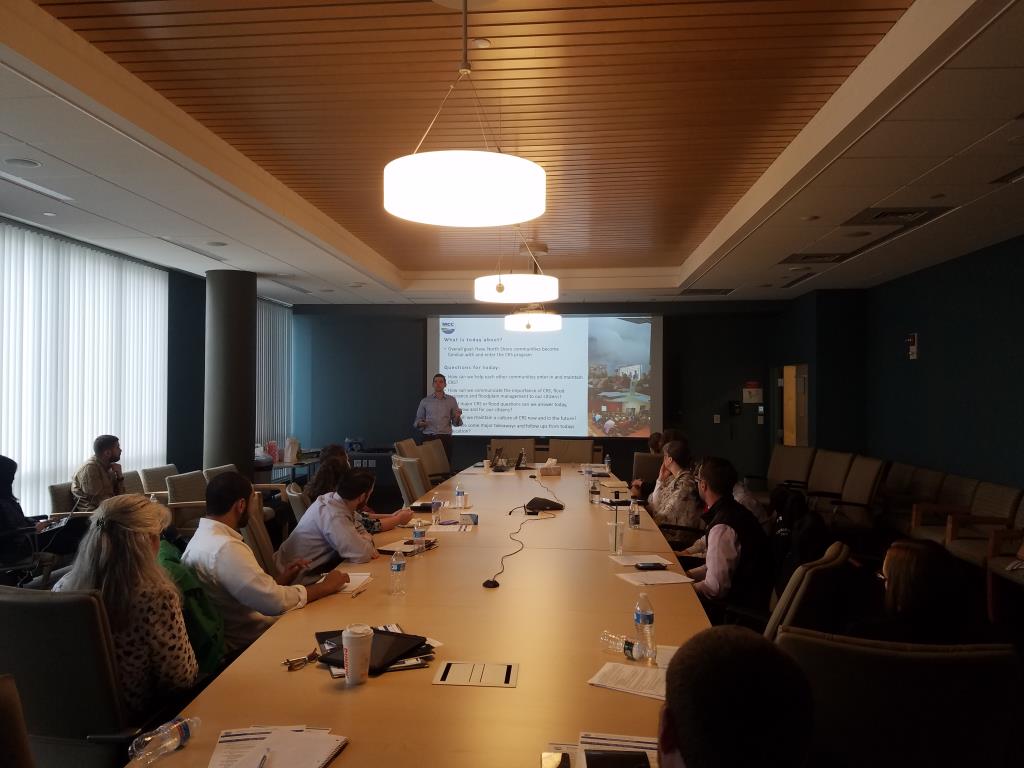
The MCC wants to encourage CRS development. In June, the MCC held a CRS symposium on the North Shore to encourage more communities to join CRS. As a follow up, the MCC is establishing CRS user groups on the North and South Shore. The intention is to encourage communities to become safer and to minimize injury and property damage. If the MCC can develop CRS user groups to increase the number of participants in the CRS program, the damaging effects of flooding can be significantly reduced on a large scale – all the time saving money to participating communities.
Note from the Chair
Halfway through 2019, it is clear that more uncertainty lies ahead for the flood insurance market. With NFIP reform in a legislative stalemate, a very difficult private flood insurance market, and Risk Rating 2.0 moving forward, the MCC is dedicated to helping our stakeholders navigate these uncertain times. Our flood insurance service center is a perfect example, with adding volunteer staff helps keep you even more informed. In addition, the MCC is now hosting a North and South Shore Community Rating System (CRS) Users Groups for professionals in Massachusetts who implement or want to implement CRS in their community. CRS helps lower community-wide risk, and lowers flood insurance premiums. As Tim talked about in his article this month, our CRS Symposium kicked off these efforts. And in our Q4 newsletter, we have even more exciting news about our H.E.L.P. program to further lower rates. While we cannot change the uncertainty in the market, we will certainly continue to add as much certainty back to your life as we can.
Joe Rossi Chair and Executive Director Massachusetts Coastal Coalition